
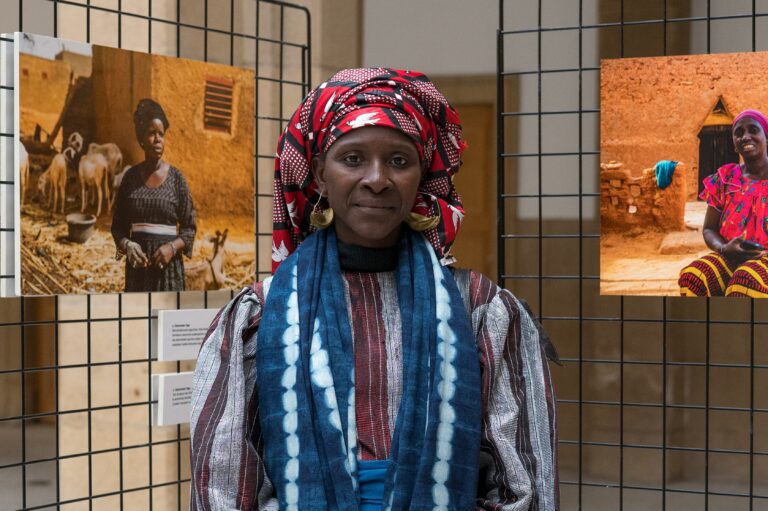
Fatoumata Diabaté, photographer of the exhibition ‘They see it clearly’
Photographer focusing mainly on Malian women, youth and culture
Fatoumata Diabaté is a Malian photographer born in Bamako in 1980. She trained in photography at the Centre de Formation Audiovisuel Promo-Femmes and at the Centre de Formation en Photographie de Bamako, where she later worked as a laboratory assistant. She also expanded her knowledge in Switzerland and Paris. Her exhibitions mainly focus on women and younger generations, exploring themes such as identity, memory, and culture in Mali.
In May, Eyes of the world inaugurated the photography exhibition “They see it clearly” at the University of Deusto, in collaboration with the Provincial Council of Bizkaia. The exhibition features a report created by Fatoumata in 2025 when she visited the Eyes of Mali project. In Mopti, women are the backbone of the rural economy and also key figures in community eye health. The exhibition portrays their silent double transformation, from working in vegetable gardens, soap production, and livestock care, to their involvement in education and the prevention of visual problems in schools.
What led you to start photography? And why did you choose to focus on women in your projects?
What motivated me was the search for autonomy. For me, freedom begins with financial independence, and I wanted to achieve that.
How do you think photography can help bring visibility to issues such as preventable blindness while also raising awareness and commitment in other contexts such as Europe?
For me, photography is a way of bearing witness and capturing real moments. That is why foundations, organisations, and institutions such as Eyes of the world work with professional photographers to help visually portray projects carried out in Africa and around the world.
As we often say, a picture is worth a thousand words. It is a very explicit medium through which we can observe new realities. For a long time, the information we receive has been strongly influenced by the images that accompany it. That is why many professionals collaborate with national and international organisations.
What would you highlight about the role of women as beneficiaries and promoters of eye health in Mopti?
In my opinion, women in Mopti benefit from the programme thanks to the confidence they gain in themselves, the professional training they receive, and the treatments and care offered by Eyes of the world. I believe this project provides them with tools to improve their living conditions.
Did you take away any lessons from the experience? What has collaborating with Eyes of the world and closely witnessing their work on the ground brought to you?
This collaboration has simply been magnificent, as I believe there has been mutual and complete trust. It has given me confidence and has become a very important experience in my life. I am grateful to have been able to carry out this project in Mali, my country, and to learn more about its interior regions, an area I love and from which I have always learned. I learn from its people, who have strength and courage and who give me new perspectives about myself and the world. It has been very interesting, and I feel happy to have discovered more parts of the community and their lives.
How would you describe this exhibition in one sentence?
For me, this exhibition has been about peace, serenity, and mediation. Nowadays, as I said, a photo is worth more than a thousand words, and those of us dedicated to photography aim to create testimony and document what is happening. The women portrayed needed someone who could reflect their experiences and work in Mopti. The exhibition is a story of sisterhood, discovery, testimonies, journeys, families, and Mali.
What would you like visitors to “They see it clearly” at the University of Deusto to feel or take away from the exhibition?
I would like visitors to experience a journey like mine through my photographs and to be able to observe and understand what they show. I hope they gain a closer perspective on the reality that those of us documenting this political conflict in the country are trying to reflect. My photographs are there to bear witness to how this security crisis, which has worsened in recent years, is affecting families.
The exhibition helps give visibility to this side of the country, and I would like to thank the Foundation for helping me do so. May the adventure continue.