
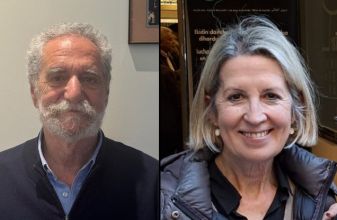
Iñaki Elorza and Lourdes García, volunteers from Munduko begiak
Journalist and music teacher
When we were still wearing masks, Iñaki Elorza went to Gizalde, a volunteer organization in Gipuzkoa, in search of a solidarity project. At the door, he ran into volunteers from Munduko begiak who were leaving a meeting: “You’ve already found your project. Don’t even ask,” they told him, inviting him to the next information session.
He went with his friends Arantza and Lourdes; all three were convinced by the proposal. Arantza could not join —although she continues to participate in awareness activities— and Lourdes and Iñaki did join. Since then, they have been part of a team where everyone contributes, leveraging their potential: Iñaki, journalist; Lourdes, music teacher. Both put, without hesitation, their network of contacts at the service of Munduko begiak.
In November, they traveled to the Sahara to learn about the project that the Foundation promotes in the Sahrawi camps in Tindouf (Algeria). They returned, despite the wear and tear of the trip, deeply proud of the impact on the Sahrawi community. Their commitment remains firm and their determination to defend the right to sight is now even greater.
What motivated you to take the step into volunteering and what previous experiences did you have?
Iñaki: I never had any serious experience in the field of volunteering, although I have always collaborated with whoever may have needed help.
Lourdes: In my case, I have always had the idea of doing volunteer work at the end of my working life; doing it during my active working life was unfeasible. It was in the Classroom of Experience, when I met Iñaki and Arantza with the same desire to volunteer, that our experience in Munduko begiak began. In my case, without previous experience in this field, except for some sporadic collaboration in my youth, in hospitals.
What did you see in Munduko begiak that convinced you to join? What distinguishes it?
Iñaki: After 37 years of professional experience in Basque public radio, and once retired, I joined the Classroom of Experience at the University of the Basque Country. There I met people who, like me, had concerns about the world of cooperation; so one day, with classmates Arantza and Lourdes, we went to the Gizalde volunteer platform in Gipuzkoa. Right at the entrance we met Iñaki Ganuza, an old acquaintance and volunteer of Munduko begiak, who invited us to the meeting that was about to begin. We went in and I don’t know if it was because of the project, because we knew some other colleague or because of the need to be a volunteer, we joined Eyes of the world and we are already in our fifth year. It was a totally unknown project, I had never heard of it, but it encouraged me to feel useful to those people in need.
Lourdes: I was attracted by the exclusive dedication to sight, something different, very important and hardly addressed, if at all, in the field of cooperation. I was particularly amazed by the aim of avoiding blindness as much as possible, with all that it entails.
What skills from your career (journalism, music or others) have served you in volunteering and what have you had to learn?
Iñaki: Not only was the project interesting, but also, from professional experience, I saw the need to extend the project and make it more visible in different media. We had to report on our activities, concerts… talks… solidarity meals… exhibitions… it needed more visibility and we are doing that little by little.
Lourdes: As a music professional, I have been able to contact musicians and institutions and organize concerts that have helped publicize the work of the Munduko begiak Foundation. On the other hand, we have had to learn how to organize activities with the aim of raising funds for specific on-the-ground actions in the different projects.
Why travel to the field and for what purpose? What specific objectives did you take to the Sahara?
Iñaki: In addition to receiving regular information through the Eyes of the world website, I believed it was very necessary to see for ourselves the reality of what we were telling the different stakeholders we met; so as soon as the opportunity arose to go to the refugee camps in the Sahara, I had no doubt that I wanted to go and learn about their reality, as well as see how Eyes of the world worked.
Lourdes: Our goal was to see with our own eyes the work that the Eyes of the world Foundation had been doing since 2001. We had good information about the work being carried out there, but we wanted to confirm it, bear witness, and, if possible, contribute to improving it within our possibilities.
A scene, meeting or person that summarizes for you the impact of the project.
Iñaki: At the airport in Algiers, we met María Tavera from Eyes of the world and the photographer Anna Mas, who were going to be companions for a week on the ground and for a lifetime spiritually. There was a connection right at the airport and it promised to be an even more interesting experience. The tiredness from the many hours of a difficult trip was immediately overcome by all the expectations and visits that María had prepared for us. The welcome by Hamudi at Tindouf airport conveyed closeness and trust, as if we had known each other forever. The same thing happened with the rest of the people we met, like Zeinabu or Dr. Naami Bakar, with whom I keep daily contact via WhatsApp. From hearsay I believed in the Eyes of the world project but verifying it there made me feel proud of the small grain of sand we contributed as volunteers.
Lourdes: Well, it is not one scene or one person alone; there are many, I cannot summarize… I mention a few: the ophthalmological infrastructure in the refugee camps with clinics in each wilaya, home assistance, screenings in schools, the shelter in Bechar… the creation of a committed and professional local team. The numerous patients in waiting rooms, in the street, waiting for ophthalmological care, etc. All this under excellent organization by the Sahara coordinator.
In what way can your experience help more people become aware of visual health? What channels or formats work best in your environment?
Iñaki: It was truly shocking to see how people worked in the different wilayas, in the different health centers, to see the needs they have… to see how much they value us, how much help is being provided… and thanks to María we even had the opportunity to visit the Ministers of Health and Culture… they had nothing but words of gratitude for Eyes of the world. It was really exciting to experience the moment when the economic aid for the coming months was confirmed by the Spanish Agency for International Cooperation… Zeinabu and her colleagues from the offices crying… overflowing with joy…
A simple, tender, unique and essential experience to continue working and helping people who need SO MUCH and have SO little.
Lourdes: Our experience can convey the reality lived on the ground, explaining the objectives of the Eyes of the world Foundation and its implementation, with the implications and consequences inherent to the work, through talks in different media, interviews in the press…